Price
Free
Event date and time
Tuesday 29 Sep 2026
3.00pm to 4.00pm AEST
Location
Online virtual event
Login details will be emailed to registrants
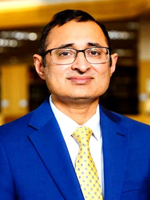
Trustworthy Deepfake Detection: Foundation Models, Neurosymbolic World Models, and Physics
Our guest speaker:
Dr. Khalid M. Malik is a Professor of Computer Science and Director of Cybersecurity at the College of Innovation and Technology,University of Michigan–Flint. He is also the founder of ProbeTruth Inc. and a member of the AI and Digital Health Innovation Center.
Pricing
-
Free
Dates and Times
Event date: Sep 2026
Tuesday 29 Sep 2026
Online virtual event
3.00pm to 4.00pm AEST
Login details will be emailed to registrants
More information
Contacts:
Kristen Moore, Shahroz Tariq and Tina Wu.
Abstract:
The rapid evolution of generative AI and multimodal foundation models is transforming the deepfake landscape, enabling the generation of increasingly realistic and coordinated audio, video, and audio-visual content. At the same time, these advances expose a fundamental limitation of conventional deepfake detectors: models that rely primarily on manipulation-specific artifacts may struggle to generalize to unseen generators, novel manipulation strategies, and rapidly evolving media distributions. This talk presents a new paradigm for trustworthy deepfake detection that integrates multimodal foundation models, neurosymbolic AI, world models, and physics-informed reasoning.
The central premise is that authentic multimedia is not simply a collection of pixels and waveforms, but an observation of an underlying world in which identities, objects, actions, speech, environments, and events evolve according to semantic, causal, temporal, and physical relationships. Multimodal foundation models provide rich continuous representations of audio and video content, capturing information about identity, speech, facial appearance, motion, actions, and context. These representations are integrated with neurosymbolic world models that explicitly encode relationships and causal dependencies across modalities and predict how an underlying state should manifest in observed audio and video. Deepfakes can then be identified not merely through the presence of known artifacts, but through inconsistencies between what is observed and what the world model predicts should occur.
Physics provides a complementary layer of constraints on what is physically possible, including facial geometry, human motion, illumination, acoustics, temporal dynamics, and audio-visual synchronization. Together, these components establish a three-layer framework:
Foundation models understand the content; world models understand how the content should behave; physics constrains what can actually happen.
This framework enables a shift from artifact-based classification toward multimodal, model-based forensic reasoning, with the potential to improve generalization to unseen deepfakes while providing localization, attribution, uncertainty estimation, and interpretable evidence. The talk will illustrate this vision across audio, video, and audio-visual deepfakes and discuss how combining foundation models with neurosymbolic reasoning and physical constraints can lead to more robust, explainable, and trustworthy multimedia forensics.
Bio:
Dr. Khalid M. Malik is a Professor of Computer Science and Director of Cybersecurity at the College of Innovation and Technology, University of Michigan–Flint, and the founder of ProbeTruth Inc. His research focuses on the integrated areas of AI, healthcare, and information security to design secure, intelligent, and decentralized decision-support systems using multimodal, federated, trustworthy, and neurosymbolic AI. In cybersecurity, his work emphasizes developing forensic examiners for assessing the authenticity, integrity, and veracity of audio, video, and image content, including deepfake detection. In healthcare, his research includes predicting cerebrovascular and cardiovascular events using clinical text and multiple medical imaging modalities, including DSA and MRA. Dr. Malik's research has been supported by multiple National Science Foundation awards, the Brain Aneurysm Foundation, the Department of Defense, the Department of Energy, the Michigan Translational Research and Commercialization Innovation Hub, and various local and global industry partners. He is the recipient of several awards, including Oakland's Young Investigator Research Award (2018), the SECS Outstanding Research Award (2019), and the Distinguished Associate Professor Award (2021).